about the fabrication
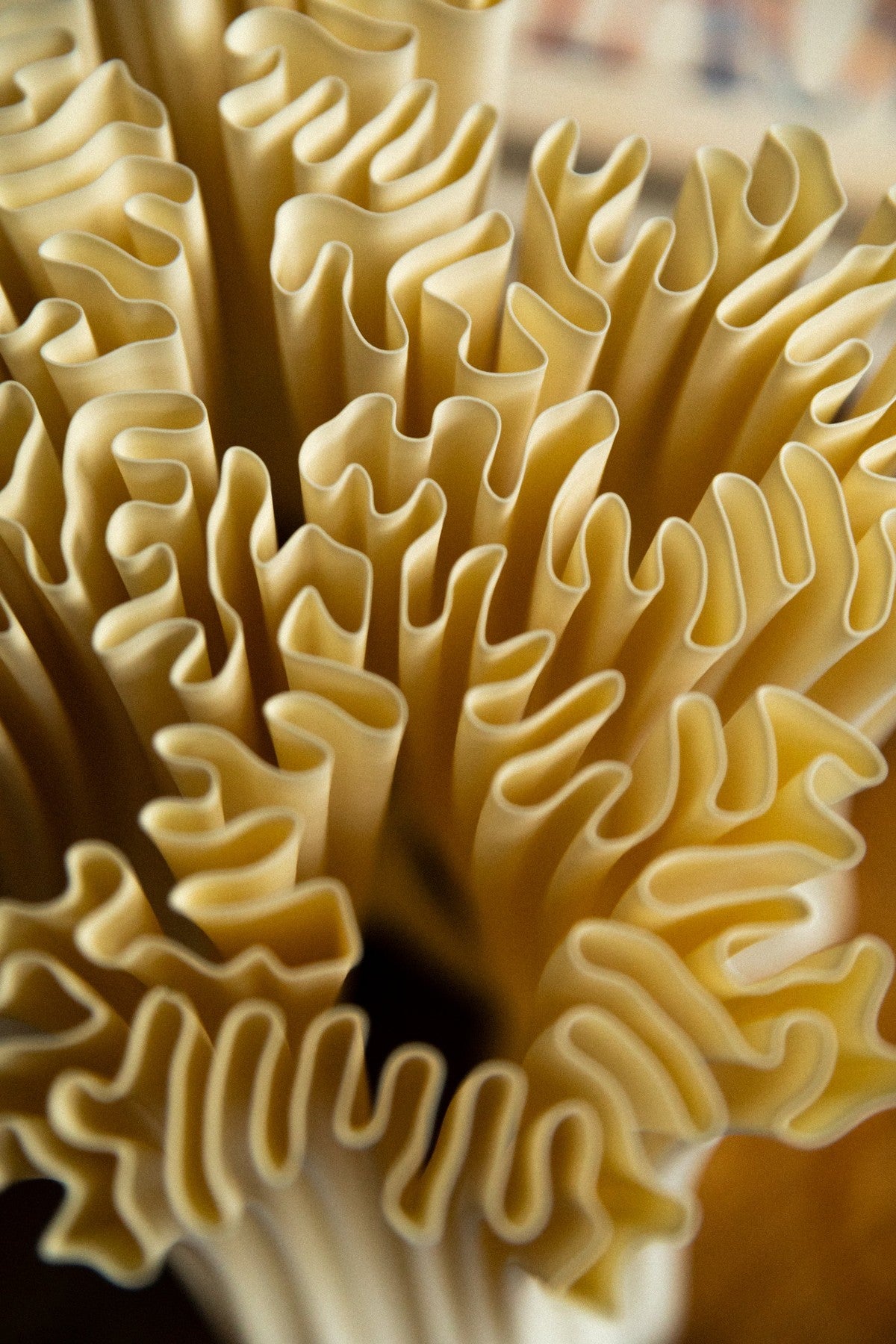
Each lamp is born layer by layer, built with precision through 3D printing technology that respects both craft and resources. Unlike traditional manufacturing that carves away or molds with excess, our process adds material only where it's needed—creating intricate, coral-inspired forms with almost no waste left behind.
This additive approach uses a fraction of the energy required by conventional production methods. No large molds, no industrial ovens, no offcuts destined for landfills. Just thoughtful, efficient creation that transforms raw biopolymer into sculptural light, one delicate layer at a time. It's manufacturing that mirrors nature itself: purposeful, efficient, and beautiful in its simplicity.
the process details
We use FDM (Fused Deposition Modeling) technology, which heats and deposits material with remarkable precision. This method gives us the freedom to create the organic, flowing forms impossible with traditional techniques—while keeping our environmental footprint minimal. Every curve and ridge you see represents material used with intention, energy spent wisely, and a commitment to making beautiful things responsibly.
Michael Jasinski
Michael's passion for technology found a pathway through mechanical engineering, where his fascination with 3D printing and nature-inspired design took root. Drawing on his research background, he found inspiration in the complex yet harmonious forms of the natural world. His work is dedicated to transforming these organic motifs into innovative and practical lighting solutions. Michael's approach is driven by a desire to make technology feel more human, crafting designs that are both visually striking and deeply connected to the environment. He aims to bring warmth and creativity to spaces by uniting the precision of engineering with the elegance of nature.

Boyan Mihaylov
Boyan started his journey in architecture, but once he discovered biomimetics - the use of nature’s engineering principles to create buildings - his interests quickly exploded into polymathic trajectories. With a decade of experience in computational modelling for design and digital fabrication, he has been programming designs that grow, evolve or improve, much like biological creatures do. He is currently on a course to expand his skill set for science, using his knowledge about algorithms to address not only design problems, but also matters of physics and biology.