about the material
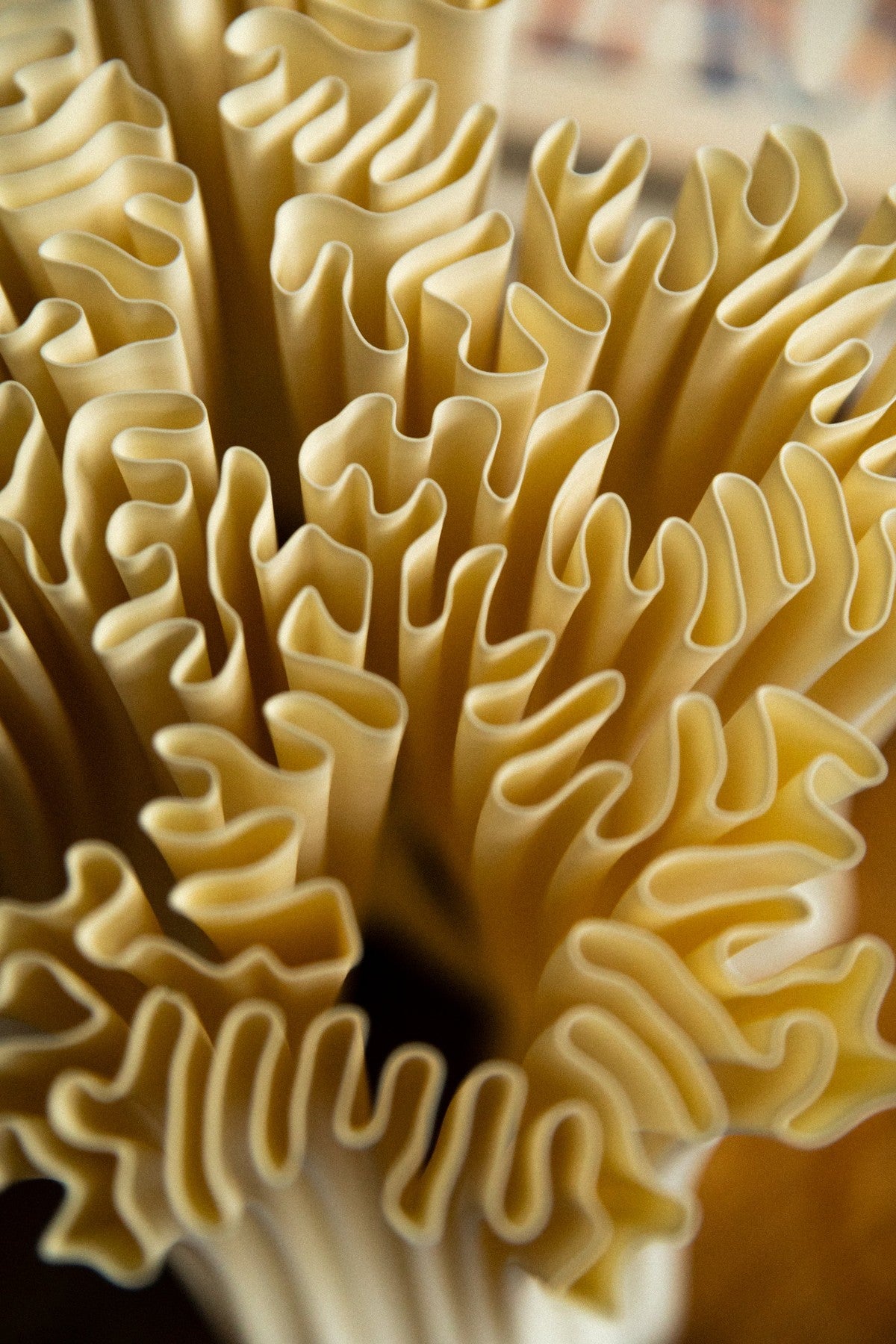
Our lamps are produced with advanced biopolymer materials — warm, durable, and renewable. These materials allow intricate geometries and organic patterns that cannot be achieved through conventional manufacturing. What may appear as a simple surface is actually the result of controlled growth processes translated into 3D form.
Using low-waste, energy-efficient 3D printing, each piece is produced with minimal environmental impact, then finished by hand to ensure quality and consistency.
The result is not just a lamp — it’s a crafted object where material, form, and light merge into a singular experience.
the technical details
For those who want to know what goes into quality you can trust:
- Industrially Compostable (ISO 14855): Biodegrades in industrial composting facilities under controlled conditions
- FDA Compliant: Materials meet strict food-contact safety standards
- RoHS & REACH Compliant: Free from harmful chemicals per European safety directives
- Flame Retardant (UL 94 HB): Heat resistant up to 115°C, meeting DIN 4102 fire safety standards
- UV Resistant: Maintains its color and form even in sunlit rooms, preserving your lamp's beauty over time
These certifications aren't just badges—they're our promise that what illuminates your home is as safe and responsible as it is beautiful.
Michael Jasinski
Michael's passion for technology found a pathway through mechanical engineering, where his fascination with 3D printing and nature-inspired design took root. Drawing on his research background, he found inspiration in the complex yet harmonious forms of the natural world. His work is dedicated to transforming these organic motifs into innovative and practical lighting solutions. Michael's approach is driven by a desire to make technology feel more human, crafting designs that are both visually striking and deeply connected to the environment. He aims to bring warmth and creativity to spaces by uniting the precision of engineering with the elegance of nature.

Boyan Mihaylov
Boyan started his journey in architecture, but once he discovered biomimetics - the use of nature’s engineering principles to create buildings - his interests quickly exploded into polymathic trajectories. With a decade of experience in computational modelling for design and digital fabrication, he has been programming designs that grow, evolve or improve, much like biological creatures do. He is currently on a course to expand his skill set for science, using his knowledge about algorithms to address not only design problems, but also matters of physics and biology.